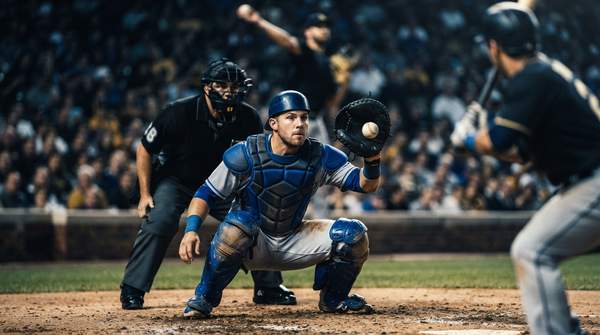
Pitch framing is the catcher's art of receiving a pitch so that an umpire is more likely to call it a strike. It matters because a single called strike can swing a plate appearance: MLB's own glossary notes that hitters posted an .806 OPS after a 1-0 count in 2025, but just a .607 OPS after an 0-1 count. MLB's Statcast system measures this skill through two linked metrics — Shadow Strike % and Catcher Framing Runs — and independent analysis has found a positive correlation between team-level framing performance and wins.
What is Pitch Framing?
MLB defines catcher framing as "the art of a catcher receiving a pitch in a way that makes it more likely for an umpire to call it a strike." That covers two directions. A catcher can turn a borderline ball into a called strike, or avoid losing a genuine strike to a "ball" call through poor receiving. Either way, the catcher is shaping the umpire's judgment on pitches where the call could go either way.
The skill operates in the gray area of officiating. On pitches down the middle, no receiving technique matters — the call is obvious. On pitches well off the plate, nothing a catcher does will save them. The leverage lives at the edges, where the umpire's discretion is highest and presentation can tip the decision. A catcher who consistently "steals" a few strikes in that band gives the pitcher a real advantage, as the Sports Analytics Group at Berkeley puts it in its analysis of the shadow zone.
The Strategic Value of a Called Strike
Why is one called strike worth so much? Because the count changes everything that follows. The gap between an 0-1 and a 1-0 count is one of the largest single-pitch swings in baseball. Per MLB's glossary, hitters reached an .806 OPS after falling behind 1-0 in 2025, versus a .607 OPS after moving ahead 0-1. That is roughly a 200-point drop in offensive production from one pitch.
For a pitcher, a stolen strike means better counts, fewer walks, more punchouts, and shorter innings. For a defense, it means weaker contact and more favorable matchups. And because a catcher handles every pitch his staff throws, the effect compounds across a full season — which is why teams now treat receiving skill as a genuine defensive weapon rather than a stylistic flourish.
Statcast's Approach: The 'Shadow Zone'
Statcast isolates framing's impact by focusing on a specific band around the plate. The shadow zone, as defined on the Statcast catcher framing leaderboard, is essentially the edges of the strike zone — roughly one ball width inside the zone and one ball width outside it. Pitches in this band are the ones most likely to be borderline, and therefore the ones where the catcher's receiving matters most.
The scale of the opportunity is meaningful: the leaderboard notes roughly 1.5 called pitches per team game fall in the shadow zone. That is the population of pitches where framing decisions actually get made. One caveat on scope: the current Statcast framing model applies only to data from the 2018 season onward, so comparisons across earlier seasons use a different methodology.