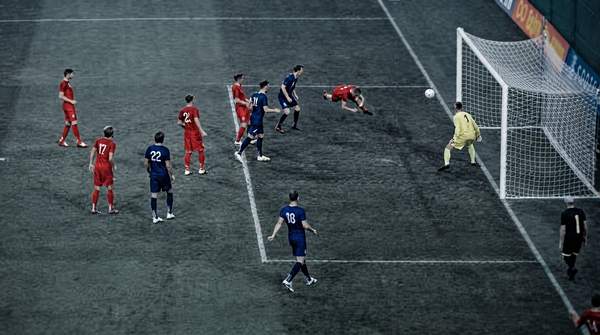
When a team wins a free kick or corner, what follows is rarely improvised. Coaches design the play, assign players to positions, and drill the routine in training. The attacking options boil down to four recognizable strategies: the direct shot, the quick restart, the simple touch for indirect kicks, and the cross into the penalty area. Learning to spot each one—and the roles behind it—turns a dead ball into the most legible moment in soccer.
Understanding Offensive Set Pieces in Soccer
Set pieces are the restarts of the game: free kicks, corner kicks, penalty kicks, goal kicks and throw-ins. Coaching frameworks, including one used at the MBP School of Coaches, classify them this way and note that each has a different objective and appears in both attack and defense. This article concentrates on the attacking side of free kicks and corners.
Free kicks near goal present a specific problem: the defense typically builds a wall of defenders between the ball and the goal. Coaching American Soccer describes the basic strategy of an offensive free kick as creating a design that defeats the wall, keeps complexity to a minimum, and ends in an effective shot on goal. The design starts with proximity to the goal—where the ball sits dictates which options make sense.
Four Primary Offensive Set Piece Strategies
Coaching American Soccer breaks free kick design into locations on the pitch, each of which could be a direct or indirect kick, meaning a team may need as many as sixteen designed plays. The features within those designs cluster into the four approaches below. The comparison distinguishes them by objective, situation and execution, so you can identify which one you are watching in real time.
Comparing Offensive Set Piece Strategies
| Strategy | Primary Objective | Best For (Situation) | Key Player Actions |
|---|---|---|---|
| Direct Shot | Score directly from the set piece | Close to goal, with a skilled taker available | Taker shoots around or over the wall, often with a bending ball to the upper corner or through a gap |
| Quick Restart | Catch the defense unprepared and exploit disorganization | When the opposition is not yet set | Taker plays the ball fast—a quick pass or through ball—while teammates anticipate and make runs |
| Simple Touch | Convert an indirect free kick into a legal shot | Indirect free kicks, where a goal cannot be scored directly | One player touches the ball to set it moving; a teammate immediately shoots |
| Cross | Deliver the ball into the danger zone for a finish | Wide or deeper positions where a direct shot is unrealistic | Delivery into the penalty area, set up similarly to a corner kick play; works for both direct and indirect kicks |
The table's logic follows from the rules and the ball's position. A direct shot only makes sense near goal with a specialist available; a cross covers the situations where distance makes a shot unrealistic; the simple touch exists specifically because an indirect free kick requires a second player's contact before a goal counts.