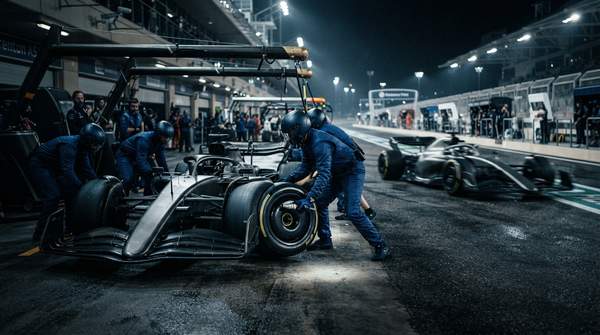
Formula 1 races are frequently decided not on the track but in the pit lane timing war. The two core maneuvers are the undercut—pitting before a rival to exploit fresh tires—and the overcut—staying out longer on worn rubber to leapfrog that rival. Aston Martin's performance director Tom McCullough explains the choice plainly: it "comes down to the tyre performance and the difficulty to overtake." Understanding that trade-off lets a fan read a race's strategic chess match as it unfolds.
The Strategic Chess Match of F1 Pit Stops
Because on-track passing is difficult at many circuits, teams treat pit stops as their primary overtaking tool. As the motorsport engineering publication Motorsport Engineer explains, the undercut and overcut are strategic maneuvers used to gain an advantage over a rival during pit stops, allowing a team to seize a lead and improve finishing position without relying on a wheel-to-wheel pass. The decision is rarely made in isolation: strategists build a pace model from data and apply it to their own strategy and to how they might interact with each competitor's car, in McCullough's description.
That modeling matters because races are unpredictable. Weather, shifting track conditions, and the actions of other drivers all force strategists to adapt plans in real time, with weather described as the most problematic influence on decisions. The undercut and overcut are therefore not fixed plans chosen before the lights go out, but live options that teams weigh lap by lap as tire data accumulates and rivals reveal their intentions.
Undercut: Gaining an Edge with Fresh Rubber
The undercut works by pitting earlier than a closely matched rival and then setting faster lap times on fresh tires. The driver banks a time advantage over the laps between their own stop and the rival's; if that advantage exceeds the time lost in the pit lane cycle, the driver emerges ahead when the rival finally stops. The objective is pure track position—converting tire freshness into a place gained.
McCullough identifies the ideal conditions: in what he calls a "track-position race" where overtaking is harder, "the undercut is the best option because you get fresh tyres earlier than your competitor and you can jump ahead of them once they've stopped." He also notes that the undercut is the more common of the two maneuvers, which reflects how often races come down to circuits where passing is at a premium. The risk is implicit in the mechanism: the undercut demands that fresh tires deliver an immediate pace advantage, so it is a bet on how the car treats new rubber relative to the rival's used set.