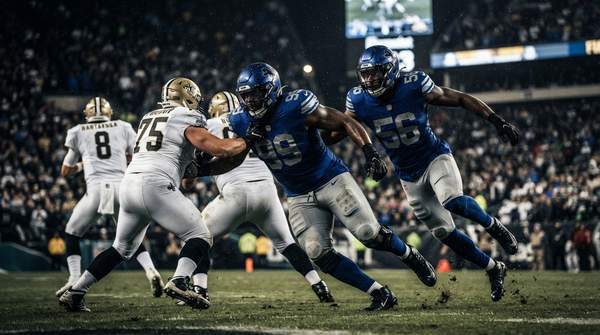
Cover 0 is football's most aggressive coverage call: pure man-to-man defense with zero deep safety help, paired with a heavy blitz designed to reach the quarterback before any receiver can get open. The name itself describes the trade — "0" means zero defenders sitting deep as a last line of defense. Every coverage player is assigned one eligible receiver and must win that matchup alone, while the defenders freed from deep responsibility rush the passer. As football coaching site vIQtory Sports puts it, Cover 0 is "a high-risk, high reward coverage that can be used in any down situation, as long as the coach feels comfortable putting his players on an island to cover the other team's receivers."
What is Cover 0 Defense?
Cover 0 is man coverage in its most basic form. Chris Haddad, writing for vIQtory Sports, explains that it is called Cover 0 "because there is 0 help deep" — players match up man-to-man against receivers while the remaining defenders blitz. Because the offense typically puts five eligible receivers into the pattern, the defense accounts for each one individually, which means as many as six players can be sent after the quarterback.
What distinguishes Cover 0 from every other numbered coverage is the absence of a free safety over the top. In most schemes, defenses keep at least one deep defender as insurance against a beaten cornerback. Throw Deep Publishing's coverage guide notes that this deep defender is traditionally valued as "the last line of defense in case an offensive player ever broke through." Cover 0 deliberately removes that insurance, converting the safety position into an extra rusher or an extra man-coverage assignment.
Player Assignments in Cover 0
In a general Cover 0 structure — one that Throw Deep Publishing describes as running "from high school all the way to the NFL" — the secondary and defensive backs are locked up in coverage, while the linebackers bring pressure from the box and force the quarterback into a split-second decision. Each defensive back mirrors his assigned receiver wherever he goes, with no zone responsibility and no help behind him.
The linebackers' role is the defining feature. Because no safety patrols the deep middle, the defense can devote an extra man to the blitz. Chad Wilson, founder of All Eyes DB Camp and a former defensive back at Miami, describes the mechanism plainly: by not having a safety back deep to help in coverage, the defense can now devote an extra man to blitz the quarterback and force the offense into mistakes. That extra rusher is what turns a standard man defense into an all-out pressure package.
The assignments are therefore simple in concept but unforgiving in execution. A covered receiver who wins his route has a clear path upfield, because the defenders playing off the line are each responsible for a specific eligible receiver rather than a zone. There is no rotation, no help and no second chance.
Strategic Objectives: Why Coaches Call Cover 0
The purpose of Cover 0 is to disrupt the quarterback's timing. Haddad identifies this as the scheme's central aim: the blitz is designed to arrive before routes develop, forcing hurried throws, sacks or turnovers. The objective is not to blanket the field but to collapse the pocket faster than the offense can respond.
Disguise amplifies this effect. Throw Deep Publishing observes that depending on how well a defense hides its intentions, Cover 0 can look like Cover 4 before the snap — particularly against a balanced 2x2 formation — so the quarterback may not recognize the pressure until it is too late to get rid of the ball in a hurry. A quarterback who reads two deep safeties pre-snap and then faces six rushers post-snap has been caught in exactly the trap the scheme is built to spring.
There is also a psychological objective. Coaches who believe the opposing quarterback cannot handle blitz pressure, as Haddad notes, see that moment as the best time to send it. Cover 0 tests not just blocking schemes but a passer's composure under maximum duress.
The High-Risk, High-Reward Nature
The reward side of the ledger is straightforward: sacks, forced fumbles and bad throws thrown away under duress. The risk side is equally stark. If one coverage player loses his one-on-one matchup, vIQtory Sports warns, it will often result in a big play or a touchdown — because there is no deep defender to clean up the mistake.
Throw Deep Publishing frames the same trade-off from the offensive perspective: it is easy for receivers to "run off" man-coverage defenders with deep routes, pulling five players away from the line of scrimmage and stretching the defense vertically. Every yard of separation a receiver creates is a yard no safety will recover.
The scheme's vulnerability to mobile quarterbacks deserves special attention. Grip Boost's coverage guide, written by Matt Furstenburg, notes that man coverage with defenders' backs turned is inherently vulnerable to quarterbacks who can escape the pocket and extend plays. Against a passer who turns pressure into scrambles, the blitz that should end the play instead becomes the play's opening act.
Cover 0 Decision Framework: When to Take the Gamble
The decision to call Cover 0 is a balance: the coordinator weighs the high potential for sacks and negative plays against the significant risk of surrendering an explosive play. The framework below organizes the situational factors the evidence identifies as pushing that calculation in one direction or the other.
| Situational Factor | Favors Calling Cover 0 | Discourages Calling Cover 0 |
|---|---|---|
| Defensive back skill level | Confident man-coverage corners who can win one-on-one matchups on an island | Defensive backs who cannot reliably mirror assigned receivers without deep help |
| Quarterback mobility | Pocket passers who struggle to escape pressure and handle the blitz | Mobile quarterbacks who escape the pocket and extend plays into scrambles |
| Quarterback composure under pressure | Coaches who believe the quarterback cannot handle blitz pressure | Passers who read disguised coverage and unload the ball quickly |
| Pre-snap disguise | Formations where Cover 0 can look like Cover 4, catching the quarterback off guard | Offenses that identify the blitz and exploit the vacated deep field |
| Coach's confidence in personnel | Staff comfortable placing players on an island in any down situation | Situations where a single beaten defender means a likely touchdown |
Read across the rows and a pattern emerges: Cover 0 is a calculated risk when the coordinator controls the variables — confident corners, a rattled or immobile quarterback, a convincing disguise. It becomes a reckless gamble when those same variables flip, because the scheme offers no margin for a single lost matchup.
Making the Call: The Cover 0 Gamble
A defensive coordinator decides to deploy Cover 0 when the potential for a game-changing sack or turnover outweighs the risk of giving up a long touchdown, based on the situational factors and personnel matchups above. The call is a bet that pressure arrives before routes develop — and that the defenders left alone can hold their ground for the seconds it takes.
The success of a Cover 0 call can be observed immediately: either the quarterback faces pressure and throws a hurried ball or takes a sack, or a receiver gets open deep for a significant gain because no help exists behind the beaten defender. That binary outcome is what makes the scheme so compelling to watch — and so consequential to call.
Sources
- The Complete Defensive Coverage Guide — vIQtory Sports
- How To Install Cover 0 — vIQtory Sports
- Coverage School: What is Cover 0 in Football? — Throw Deep Publishing
- How To Play Cover 0 — All Eyes DB Camp - DB Training, Education & Resources
- Man vs Zone Coverage: Football Coverage Schemes Explained — Grip Boost